Of the three UFO videos the Pentagon officially released in 2020, one has a moment that still stops people mid-sentence. In a 34-second infrared clip filmed from a U.S. Navy fighter jet, a strange object glides across the sky — and then appears to turn, slowly, on its own axis, as if it were rotating in mid-air. The pilots watching it can be heard reacting in real time. The video is called GIMBAL, and it is one of the most studied pieces of military UFO footage in history.
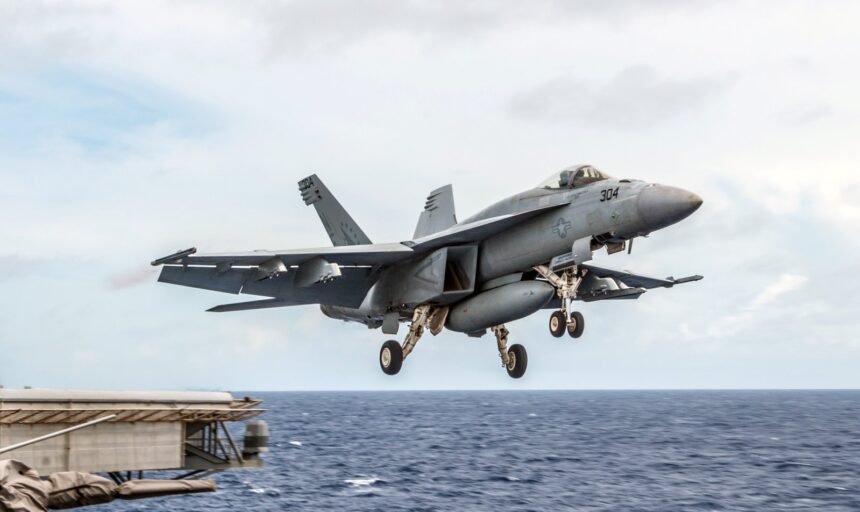
The footage was recorded on January 20, 2015, by the crew of an F/A-18F Super Hornet flying from the aircraft carrier USS Theodore Roosevelt off the East Coast of the United States. The Pentagon released it formally on April 27, 2020, confirming it was authentic and that the object in it remained unidentified. No file released since — including the Pentagon’s own UAP archive — has produced proof of alien technology. But the GIMBAL video is still unexplained, and that is exactly why it matters.
What the GIMBAL video shows
The clip was recorded with the jet’s Raytheon AN/ASQ-228 Advanced Targeting Forward-Looking Infrared (ATFLIR) pod, which films in infrared and shows heat as bright shapes against a dark sky. The object appears as a bright, elongated shape, roughly like a saucer seen edge-on, moving steadily from right to left above a broken layer of cloud.
What gave the video its name is the rotation. As the object travels, it appears to pivot smoothly, turning roughly 180 degrees while its direction of travel does not change. The crew reported that it was flying into a wind of about 120 knots — a strong headwind — yet it held its course without any visible wings, exhaust plume, or means of propulsion.
The audio is as striking as the picture. The crew can be heard exclaiming as they track the object, with one voice saying there is “a whole fleet of them” — suggesting the object on screen was only one of a larger group just outside the camera’s frame.
The pilots who kept seeing them
GIMBAL was not a one-off sighting. It came from a wave of encounters in 2014 and 2015, when aircrew flying from the USS Theodore Roosevelt began detecting unknown objects on their sensors almost every day. The detections began after the squadron’s F/A-18 Super Hornets received a radar upgrade to the Raytheon AN/APG-79 Active Electronically Scanned Array (AESA) system — and suddenly the objects were there, on the screens, in restricted training airspace off Virginia Beach and later off Jacksonville, Florida.
The clearest first-hand account comes from Lieutenant Ryan Graves, a former F/A-18F pilot with strike fighter squadron VFA-11, the Red Rippers. Graves has described, in interviews and later in sworn testimony to the U.S. Congress in July 2023, objects that held station in high winds, stayed aloft for hours without refueling, and showed no transponder signal, exhaust, or visible means of lift.
In late 2014, Graves said, two Hornets flying in formation had an object pass between them — described as a dark cube suspended inside a translucent sphere, within about 50 feet of one aircraft. The Navy treated the reports as a flight-safety problem, and the hazard reports moved through official safety channels.


From leak to official release
The public first saw GIMBAL on December 16, 2017, when The New York Times published it alongside its investigation into the Pentagon’s secret Advanced Aerospace Threat Identification Program (AATIP). A second Roosevelt video from the same period, GOFAST, followed in March 2018. Both clips had been provided to the press by Christopher Mellon, a former Deputy Assistant Secretary of Defense for Intelligence.
Then, on April 27, 2020, the Department of Defense formally declassified and released all three videos — FLIR1 from the 2004 Nimitz incident, GIMBAL, and GOFAST — confirming they were authentic Navy footage and that the objects in them were unidentified. It was the Navy’s first formal acknowledgment in decades that it possessed and stood behind footage of this kind.
The skeptical case — and what it cannot settle
Skeptics have attacked the videos themselves more effectively than the wider radar pattern behind them. The best-known analysis, by investigator Mick West, argues that GIMBAL’s apparent rotation is an artifact of the camera: the glare of a distant jet’s hot exhaust rotating as the targeting pod itself turns to track it. Under this reading, the “rotating object” is a conventional aircraft seen through infrared glare.
The GOFAST clip has a similar problem. Parallax analysis using the pod’s own on-screen telemetry suggests the small white object was not skimming the ocean at high speed, as it first appears, but was a slower object much closer to the camera, with its apparent speed created by the jet’s own motion.
But neither explanation settles the Roosevelt encounters as a whole. The radar detections, the visual sightings by multiple aircrew, the near-miss with the cube-shaped object, and the near-daily pattern across months are not explained by a camera artifact in a 34-second clip. The U.S. intelligence community’s own first assessment, published by the Office of the Director of National Intelligence in June 2021, reviewed 144 reports and left 143 unexplained.
The three Pentagon videos at a glance
| Video | Recorded | Where | What it shows |
|---|---|---|---|
| FLIR1 (“Tic Tac”) | November 14, 2004 | Off Southern California, USS Nimitz | White oval object with no wings or exhaust |
| GIMBAL | January 20, 2015 | Off U.S. East Coast, USS Theodore Roosevelt | Object that appears to rotate 180 degrees in flight |
| GOFAST | January 2015 | Off U.S. East Coast, USS Theodore Roosevelt | Small white object apparently skimming low and fast |
| All three | — | — | Formally released by the Pentagon on April 27, 2020 |
What is still unproven
Eleven years after it was filmed, the GIMBAL object is still officially unidentified — and unidentified is not the same as alien. The Pentagon’s own UAP office, AARO, concluded in its March 2024 report that it found no evidence of alien technology, and no file in the Pentagon’s declassified UAP archive has produced proof of non-human craft.
What the video does prove is narrower, and more useful: that trained Navy aircrew, flying some of the best sensor equipment in the world, repeatedly detected things they could not identify, reported them through official channels, and were taken seriously enough that the Pentagon eventually released the footage itself. The rotation may one day be fully explained. The wave of detections behind it has not been.
Sources: U.S. Department of Defense release of April 27, 2020; The New York Times, December 16, 2017; U.S. Navy statements; Lt. Ryan Graves, testimony to the U.S. House of Representatives, July 2023; Office of the Director of National Intelligence, Preliminary Assessment: Unidentified Aerial Phenomena, June 2021; AARO Report on the Historical Record of U.S. Government Involvement with Unidentified Anomalous Phenomena, March 2024. The GIMBAL video is U.S. government footage in the public domain.