On the evening of November 17, 1986, a Japan Airlines cargo jet crossing the dark skies of Alaska reported something its three-man crew could not explain: bright lights that paced their Boeing 747 for nearly 50 minutes, appeared on radar, and then vanished. Almost 40 years later, the case remains one of the most thoroughly documented pilot UFO sightings in aviation history — and one of the most fiercely debated.
A Routine Cargo Flight Over Alaska
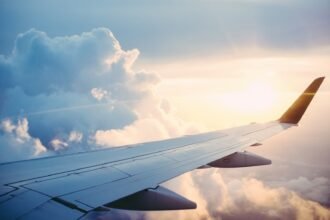
Japan Air Lines Cargo Flight 1628 was a Boeing 747-200F freighter flying from Paris to Tokyo, with a scheduled stop in Anchorage, Alaska. Its cargo that night was French Beaujolais nouveau wine. On board were three crew members: Captain Kenju Terauchi, a veteran pilot with more than 10,000 hours of flight time, First Officer Takanori Tamefuji, and Flight Engineer Yoshio Tsukuba.
The flight had been uneventful across the North Atlantic. At about 5:09 p.m. Alaska time, cruising at 35,000 feet over eastern Alaska near Fort Yukon, the crew noticed unusual lights ahead of their aircraft, slightly below them.
What the Crew Saw
At first there were two groups of lights — yellow, amber, and green — ahead of the 747 at roughly the 11 o’clock position. Captain Terauchi radioed Anchorage air traffic control at about 5:19 p.m. to report unidentified traffic. The controller could see only Flight 1628’s own transponder return on his radar scope.
Over the next minutes, the lights appeared to resolve into two distinct craft, which Terauchi later described as rectangular or square-shaped, with arrays of glowing nozzles or thrusters. The objects maneuvered in front of the jet, darting to the left and snapping back to center. At one point, Terauchi said the light was so intense at close range that he could feel warmth on his face through the cockpit windshield.
The “Mothership”
Then, at about 5:31 p.m., the two smaller objects moved away — and something far larger appeared. In a longer interview on January 2, 1987, Terauchi described an enormous, walnut-shaped object, dark and silhouetted, which he estimated as twice the size of an aircraft carrier. He said it followed the 747 for much of the remaining encounter.
The crew reported that the objects stayed with their aircraft for roughly 400 miles. Anchorage controllers authorized a descent from 35,000 to 31,000 feet and a full 360-degree turn, but the lights remained with the plane even after the maneuvers. The crew finally lost visual contact at about 5:53 p.m., shortly before landing in Anchorage.
What the Radar Showed
Radar is what makes this case different from a simple lights-in-the-sky story. The 747’s own weather radar showed a return about seven to eight miles away. Military radar at Elmendorf Air Force Base briefly detected a primary return — a target with no transponder signal — near the flight, though it faded quickly.
But the radar picture was messy. Anchorage controllers reported a radar hit about five miles behind the 747 at one point, while the flight placed the traffic ahead of them. A United Airlines airliner and a U.S. Air Force C-130 cargo plane flying nearby reported seeing nothing, either visually or on radar. Fairbanks controllers saw only Flight 1628 on their scopes.
The FAA Investigation
After landing, all three crew members were interviewed by Federal Aviation Administration agents the same night. The FAA later investigated the crew reports and the available radar data. Its conclusion was cautious: the agency said it could not confirm the event. The military radar images were dismissed as clutter, and the object on the FAA’s own screens was thought to be a coincidental split image of the 747 itself — a radar echo that appears as a false second target.
Skeptics offered a simpler explanation. UFO investigator Phillip J. Klass, writing in early 1987, pointed out that the planets Jupiter and Mars were in the area where Terauchi said he saw the two lights, and argued the captain had likely mistaken the bright planets for craft. That explanation is disputed: astronomer Walter Webb noted in a July 1987 letter that when the sighting began, the lights were about 30 degrees to the left of the plane’s heading, while Jupiter was more than 70 degrees away.
The Case in Numbers
| Date | November 17, 1986 |
| Flight | Japan Air Lines Cargo Flight 1628 (Boeing 747-200F) |
| Route | Paris → Anchorage → Tokyo |
| Crew | 3 (Captain Kenju Terauchi, First Officer Takanori Tamefuji, Flight Engineer Yoshio Tsukuba) |
| Altitude | 35,000 feet |
| Duration of sighting | About 45–50 minutes |
| Distance followed | About 400 miles |
| Other aircraft checks | United Airlines jet and USAF C-130 saw nothing |
| FAA conclusion | Could not confirm the event |
What Is Still Unproven
The JAL 1628 case has something most UFO stories do not: three professional witnesses, a written FAA file, radio transcripts, and radar returns discussed in real time with air traffic control. It also has something the strongest cases share: a credible ordinary explanation that has never been fully settled, and official records that stop short of an answer.
No wreckage was recovered. No photograph was taken. No file released since — including the Pentagon’s declassified UAP files — has identified what the crew saw. And no evidence in any official file has shown that the objects were alien technology. The FAA’s own position remains what it was in 1987: the event could not be confirmed.
That is why the case still matters. It shows how a sighting can be real to trained observers, partially supported by instruments, and still end without an explanation — the exact gap the Pentagon’s UAP office, AARO, was created to close.
Sources: FAA public file on the JAL 1628 case (1987); Wikipedia, “Japan Air Lines Cargo Flight 1628”; UAP Codex case file on JAL 1628; contemporary reporting on the FAA investigation.