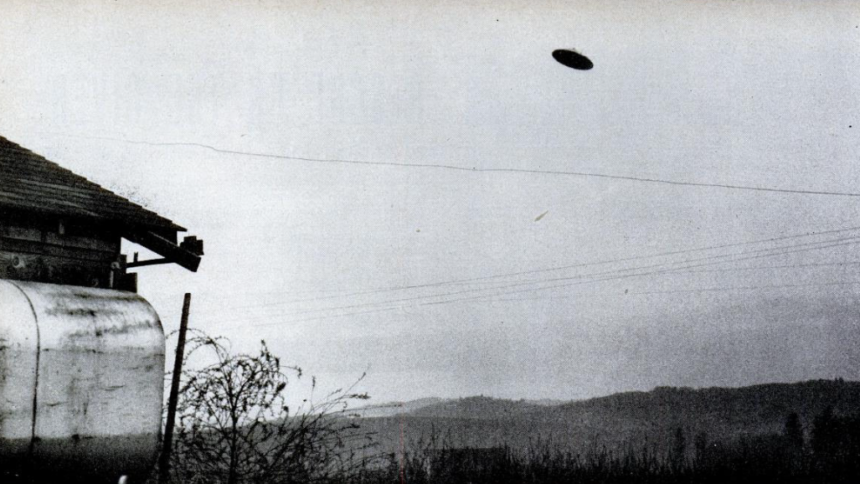
On the evening of May 11, 1950, a farmer’s wife in Oregon stepped outside to feed her rabbits — and came back with two of the most famous photographs in UFO history. Paul and Evelyn Trent, a farming couple near McMinnville, Oregon, captured a silvery, disc-shaped object in the sky above their farm. The two pictures were printed in Life magazine, investigated by the U.S. Air Force, and studied by a government-funded team of scientists. Seventy-five years later, the McMinnville photographs are still argued over — and still officially unexplained.
An Evening Chore Turns Into a Sighting
At about 7:30 p.m. on May 11, 1950, Evelyn Trent was walking back to the farmhouse after feeding the caged rabbits on the family farm outside Sheridan, a small town southwest of McMinnville. She noticed a large, metallic-looking object in the sky to the northeast. Startled, she called her husband Paul, who was inside the house.
Paul Trent, a 43-year-old farmer, came out and saw it too: a round, shiny, wingless object, hovering in the sky. He grabbed the family camera — a basic Kodak Roamer — and managed to take two photographs in quick succession, within about 30 seconds, as the object moved slowly westward and then northwest before disappearing from sight. The Trents later estimated the object was roughly 30 feet across and came within about a quarter of a mile of their position. The photographs show a disc with a flat underside and a domed top, hanging in the air above the farm.
| Fact | Detail |
|---|---|
| Date and time | May 11, 1950, about 7:30 p.m. |
| Location | The Trent farm near McMinnville, Oregon, USA |
| Witnesses | Paul Trent (43) and Evelyn Trent, farmers |
| Camera | Kodak Roamer; two photographs taken within about 30 seconds |
| Object | Silvery, metallic, disc-shaped; flat underside, domed top; estimated about 30 feet across |
| First publication | McMinnville Telephone-Register, front page, June 8, 1950; Life magazine, June 26, 1950 |
| Official status | Project Blue Book: “unknown”; Condon Committee: “difficult to explain in a conventional way” |
The Photos Go Public

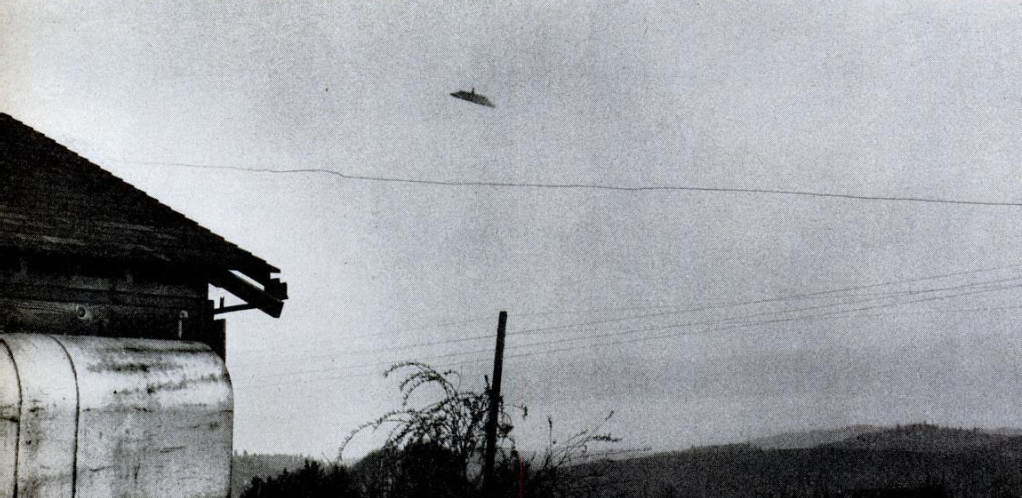
The Trents were not eager for publicity. They thought they might have photographed a secret military aircraft, and they were worried about getting into trouble, so they hid the film at first. They finished the roll over the following weeks and only showed the pictures to friends and neighbors. Word reached a local reporter, who persuaded the couple to hand over the negatives. On June 8, 1950, the McMinnville Telephone-Register ran the story and the two photos on its front page.
The wire services picked the story up, and it spread across the country. On June 26, 1950, Life magazine published cropped versions of the images, along with a photograph of Paul Trent and his camera. The Trents were promised the negatives would be returned. Life told them the negatives had been misplaced — and the couple did not get them back for decades. They also never received any money for the photographs, despite the pictures being reprinted around the world.
Read also: Project Blue Book: How the US Air Force Investigated 12,618 UFO Sightings
The Air Force Investigates
The photographs entered the official record when they were submitted to the U.S. Air Force and examined as part of Project Blue Book, the Air Force’s UFO investigation program. Blue Book investigators interviewed the witnesses and studied the photographs. They found no evidence of a hoax in either the interviews or the photographic analysis, and they assessed the Trents as sincere. But they could not identify the object, so the case was given the designation “unknown” — the Air Force’s label for a sighting with no conventional explanation.
The most important analysis came years later. In 1967, the lost negatives were found in the files of United Press International, which had absorbed the earlier news service. The negatives were loaned to William K. Hartmann, an astronomer working as an investigator for the Condon Committee — the government-funded UFO study led by physicist Edward Condon at the University of Colorado Boulder.
Hartmann interviewed the Trents and was impressed by their apparent sincerity. He could find no evidence that they had ever tried to profit from the photographs. His conclusion, published in the Condon Report in 1969, was striking: “all factors investigated, geometric, psychological, and physical, appear to be consistent with the assertion that an extraordinary flying object, silvery, metallic, disk-shaped, tens of meters in diameter, and evidently artificial, flew within sight of two witnesses.” The report classed at least one of the photographs as “difficult to explain in a conventional way.” Of the many cases the Condon Committee examined, McMinnville was one of the few it could not dismiss.
The Skeptics Answer Back
Not everyone accepted Hartmann’s conclusion. Skeptics Philip J. Klass and Robert Sheaffer argued the photographs were a hoax — most likely a small model suspended by string or wire from the power lines visible at the top of the uncropped photographs. (Life magazine’s published version had cropped those power lines out of the frame.) They also pointed to lighting discrepancies and noted that the object’s shape resembled a common automotive mirror of the era.
Ufologist Bruce Maccabee pushed back with his own detailed analysis, arguing that the apparent aerial perspective in the images — the way the object relates to the distant landscape — was inconsistent with a small model hanging close to the camera. The argument has never been settled. Both sides have re-analyzed the same two negatives for decades, and the photographs remain among the most technically studied UFO images ever taken.
What Is Still Unproven
Here is the honest bottom line. The McMinnville photographs are real photographs of something in the sky over Oregon on May 11, 1950 — that much is documented by the negatives themselves, by the witnesses’ consistent testimony over 47 years, and by two official investigations that found no evidence of a hoax. But no file connected to the case contains proof of alien technology. The Pentagon’s UFO office, AARO, concluded in its March 2024 historical report that it found no evidence that any U.S. government investigation had confirmed a UAP sighting as extraterrestrial technology. That finding stands, and it covers this case too.
What the case actually proves is narrower — and still remarkable. Two named witnesses, who never sought money or fame, photographed an object the Air Force could not identify and a government scientist could not explain in conventional terms. The skeptics’ model theory has never been proven either. Seventy-five years on, the McMinnville photographs sit in the same category as the best UFO evidence of all: genuine, documented, and unresolved. “Unidentified” is a statement about what we know — not about what was in the sky.
Read also: UFO Sightings in the USA 2026
Why McMinnville Still Matters in 2026
The McMinnville photographs matter because they are the case where the strongest photographic evidence and the weakest conclusion meet. There are no anonymous witnesses here. There is no single blurry frame. There are two clear photographs, original negatives, a published paper trail from June 1950, and two official investigations that both ended at “unknown.”
That is the right way to hold the case: as the most famous UFO photographs ever taken — and as a reminder that a photograph can be completely genuine and still not be an answer. Until some future analysis finally settles what Paul Trent’s camera caught above that Oregon farm, the silver disc over McMinnville will remain exactly what the Air Force called it in 1950: unidentified.