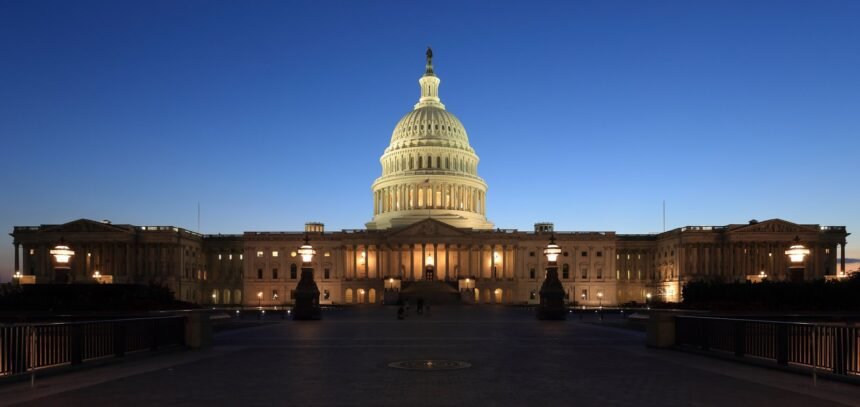
In July 2023, the most powerful Democrat in the U.S. Senate tried to do something no UFO law had ever done: force the federal government to hand over its secret files on unidentified anomalous phenomena — and, if necessary, seize any crashed UFO material held by private companies. The bill was called the UAP Disclosure Act. It nearly became law. Then, in a closed-door negotiation, its two strongest provisions were cut out. Three years later, in July 2026, the House of Representatives brought the full act back. Here is what the law proposed, what Congress removed, and why the fight is still open.
What the 2023 Bill Would Have Done
Senate Majority Leader Chuck Schumer of New York and Senator Mike Rounds of South Dakota introduced the Unidentified Anomalous Phenomena Disclosure Act on July 13, 2023, as an amendment to the annual defense bill, the National Defense Authorization Act for Fiscal Year 2024. Senators Marco Rubio, Kirsten Gillibrand, Todd Young, and Martin Heinrich signed on as co-sponsors. The bill was modeled on the 1992 law that forced the release of the JFK assassination files, and it carried a simple idea: the public has a right to know what the government knows about UAP.
The original text would have:
- Created a UAP Records Collection at the National Archives, with a presumption of immediate disclosure.
- Set up an independent, nine-member UAP Records Review Board, appointed by the president, to decide what could stay secret.
- Required every UAP record to be released no later than 25 years after the law took effect, unless the president certified a specific harm to national security.
- Given the federal government eminent domain over “any and all recovered technologies of unknown origin” and “biological evidence of non-human intelligence” held by private companies or individuals.
That last provision was the most explosive part. It was written for one specific fear: that crashed material, if it exists, is sitting in the hands of defense contractors, outside the reach of Congress.
The Whistleblower Who Forced the Issue
The timing was no accident. On June 5, 2023, former intelligence officer David Grusch’s allegations were published by The Debrief: he claimed the U.S. government has run a decades-long crash-retrieval and reverse-engineering program, with recovered materials held by private contractors. Grusch gave a televised interview on June 11, and on July 26, 2023, he testified under oath before the House Oversight Committee, repeating the claim in public. Schumer and Rounds filed their amendment thirteen days before that hearing.
Grusch’s claims have never been confirmed by any public evidence, and the Pentagon has repeatedly denied that any such program exists. But his testimony gave the disclosure bill its political fuel — and its critics their main argument that the law was built on unproven claims.
What Congress Cut in December 2023
The Senate passed its version of the defense bill with the disclosure act attached. The House would not accept most of it. In the closed-door conference that reconciled the two bills, the review board and the eminent domain provision were stripped out. In a floor exchange on December 13, 2023, Schumer said that, for the first time, the National Archives would gather UAP records from across the government with a legal mandate to release them. Rounds listed what was lost: the independent board, and the power to obtain recovered material or biological remains from private hands.
President Biden signed the slimmed-down defense bill into law on December 22, 2023. What survived was a UAP records collection at the National Archives — now held as Record Group 615 — but the decision about what stays secret remained with the very agencies that hold the records.
| Date | What Happened |
|---|---|
| June 5, 2023 | Grusch’s crash-retrieval allegations are published by The Debrief |
| July 13, 2023 | Schumer and Rounds file the UAP Disclosure Act (Senate Amendment 797) |
| July 26, 2023 | Grusch testifies under oath before the House Oversight Committee |
| December 22, 2023 | The FY2024 defense bill is signed — review board and eminent domain cut |
| July 2024 / July 2025 | The full act is refiled as amendments to later defense bills — neither adopted |
| December 18, 2025 | The FY2026 defense bill adds three narrower UAP provisions instead |
| July 22, 2026 | The House adopts the full UAP Disclosure Act in its FY2027 defense bill |


The Comeback: The House Vote of July 2026
Schumer and Rounds did not give up. They refiled the full bill as amendments to the next two defense bills, in July 2024 and again in July 2025, when it was filed as Senate Amendment 3111. Neither version was adopted. The defense bill signed on December 18, 2025, added three smaller UAP provisions instead, covering data sharing and reporting rules.
Then the fight moved to the House. Led by Representative Eric Burlison of Missouri, with bipartisan co-sponsors, the full UAP Disclosure Act was offered again as an amendment to the House defense bill for fiscal year 2027. On July 22, 2026, the House adopted it as part of a bundle of amendments, and then passed its defense bill, H.R. 8800, by 216 votes to 212. The new version would restore the nine-member review board, give it subpoena powers, set statutory deadlines for agencies, and revive the eminent domain clause for recovered material, “should it exist.”
As of late 2026, the outcome is genuinely open. The Senate’s own defense bill contains nothing of the kind, so the act’s fate now depends on negotiations between the two chambers. Supporters say it is the closest the bill has ever come to becoming law. Critics say the Senate will strip it out again, just as it did in 2023.
What Is Still Unproven
One thing the disclosure fight has not changed: no public evidence of alien technology has been found in any government file released so far. The Pentagon’s All-domain Anomaly Resolution Office reviewed 80 years of UFO records for its 2024 report and found no evidence of alien technology, reverse-engineering programs, or secret crash retrievals. NASA’s own UFO study in 2023 reached the same conclusion: no evidence of alien craft.
That is exactly why the disclosure act matters to its supporters — and why its opponents call it unnecessary. The law is not about proving that aliens visited Earth. It is about who gets to decide what the public can see: an independent board, or the agencies that collected the files. Until the records are released, the most important question in the UFO debate remains unanswered by evidence, not by argument.