In June 2026, two Federal Special Agents watched a matte-black triangle rise over a ridge line near a sensitive U.S. military site, hover in total silence, and then streak away so fast that the FBI’s own paperwork puts its speed at about 1,800 miles per hour. The Pentagon released their account on October 23, 2026, in the seventh batch of its declassified UAP files. There is just one problem: the Pentagon’s own second document about the same sighting says the dash took ten times longer. The files disagree with each other, and neither side has been proven right.
What the Pentagon released
The account comes from PURSUE Release 07, published on October 23, 2026, under the Presidential Unsealing and Reporting System for UAP Encounters (PURSUE), the program that has been releasing formerly classified UAP files in batches since May 8, 2026. The seventh batch contains 28 new files, all PDF documents, and it brought the public archive to 478 files. Like the earlier batches, it mixes old material from the 1940s, 1950s and 1960s with new material from this year. And like every batch before it, it contains no smoking gun: nothing in these files proves that alien craft are visiting Earth.
The triangle case is the newest sighting in the release, and it drew coverage from CBS News, The Guardian, Scientific American, Axios and the New York Post. It is also the strangest, because the government’s own paperwork tells the story two different ways.
Two agents, a triangle, and twenty seconds of silence
According to the AARO memorandum for record, the sighting took place over two days in June 2026 at a sensitive national security site in the western United States. The exact place and the exact dates are redacted from the released files. The All-domain Anomaly Resolution Office (AARO), the Pentagon office that investigates UAP reports, interviewed two Federal Special Agents and added a corroborating account from a third official who watched from a separate observation post. AARO said the case warrants further investigation because the object’s reported shape and flight matched other reported incidents in the western United States.
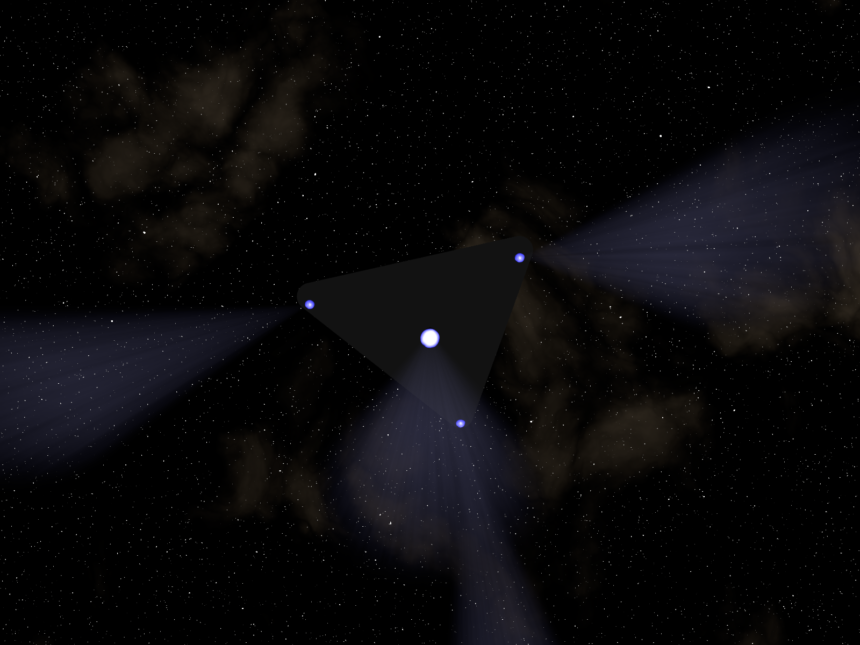
The witnesses described a triangular object, matte black, 13 to 15 feet (4 to 5 meters) wide, 6 to 9 feet (2 to 3 meters) long and only 1 to 2 feet (0.3 to 0.6 meters) thick. It climbed about 200 to 300 feet (60 to 90 meters) above the local ridge line and then suddenly stopped and hovered for about 20 seconds. Then it went into high-speed horizontal flight. There was no engine roar, no rotor hum, no exhaust and no noise of any kind. The AARO memo put it in plain words: “Absolute acoustic silence persisted throughout the high-velocity phase.”
The sighting at a glance
| Detail | What the files say |
|---|---|
| When | June 2026, over two days (exact dates redacted) |
| Where | A sensitive national security site in the western United States (location redacted) |
| Witnesses | Two Federal Special Agents, plus a third official at a separate post |
| Shape and color | Triangular, matte black, most resembling a delta-wing drone |
| Size | 13-15 ft wide, 6-9 ft long, 1-2 ft thick |
| Hover | About 20 seconds, 200-300 ft above the ridge line |
| Sound | None — “absolute acoustic silence” |
| Speed claim | About 1,800 mph (FBI) or about 180 mph (AARO) — see below |
| Physical evidence | None — no wreckage, scarring or vegetation damage found |
| Official status | Unresolved; AARO says it warrants further investigation |


The 3-second problem: one dash, two speeds
Here is where the files part ways. The FBI statement, a signed FD-302 form, says the object covered roughly a mile and a half in about three seconds before dropping into a canyon. The report’s own math puts that dash at roughly 1,800 miles per hour. The AARO memorandum on the very same encounter, document DOW-UAP-D176, describes the same movement taking about 30 seconds. That is a tenfold difference, and it runs straight through every speed drawn from the story. At 30 seconds, the same mile and a half works out to roughly 180 miles per hour — fast for a small drone, but nothing extraordinary.
Both documents agree on one important limit: the speed is an observer’s estimate. There is no photograph, no video and no instrument reading of the object. The file itself says so. So the famous 1,800 mph figure is not a radar measurement. It is what two people watching with their eyes thought they saw, written down in a formal statement — and the Pentagon’s own analysts recorded a different time for the same flight.
The morning after: nothing on the ground
A ground survey of the canyon was carried out the following morning. It found no wreckage, no ground scarring and no vegetation damage. Whatever crossed that ridge left no mark behind. That cuts both ways: it rules out a crash or a hard landing, but it also means there is no physical evidence to test. The case now sits in the Pentagon’s archive the same way the archive itself describes its contents — as an unresolved case, meaning the government is unable to make a definitive determination about what was observed.
The New York Post’s review of Release 07 counted three separate black-triangle reports over sensitive sites in the past year. Black triangles are among the oldest shapes in UAP lore, with sporadic records going back to the 1950s and 1960s and a surge in the 1980s and 1990s. The most famous wave came over Belgium in 1989 and 1990, when about 2,600 reports were filed and two F-16 jets were scrambled to chase a triangle nobody could identify.
Read also: The Phoenix Lights of 1997: Thousands Saw a Giant V in the Arizona Sky — and It Is Still Debated
Why this case matters — and what it does not prove
This case matters because of who saw it and how it was recorded. These were not anonymous callers. They were federal agents, interviewed formally, with a second official confirming the account from another position, and the file was investigated by both AARO and the FBI. Cases with trained observers and written records are exactly the kind the Pentagon says it takes seriously.
But it is equally important to say what the case does not prove. It does not prove the object was alien technology. It does not prove it was a secret aircraft, either. The files contain no photo, no radar track and no recovered material, and the two official accounts cannot even agree on how long the dash lasted. The most honest summary is the one the Pentagon itself uses: unresolved.
That is the pattern across all eight PURSUE releases so far. The files are real, the witnesses are often credible, and the explanations are still missing. But in none of the 521 records released to date has the Pentagon produced proof of alien technology. Until a case arrives with data that can be checked — a clear image, a radar track, a piece of hardware — the black triangle of June 2026 stays where the government put it: a genuine mystery, and an unsolved one.