On a Saturday afternoon in May 1967, a Winnipeg mechanic out looking for minerals near a quiet Canadian lake said he walked up to a landed disc-shaped craft, heard voices coming from inside it, touched its surface — and was burned so badly by its exhaust that he needed hospital treatment the same night. The case was investigated by the Royal Canadian Mounted Police, the Royal Canadian Air Force, and Canada’s Department of National Defence. Nearly 60 years later, the file is still listed as unsolved.
It is one of the most carefully documented UFO cases in history — and one of the most cautionary. The burns were real and medically recorded. The radioactive soil was real and measured. But neither one proves what the witness said caused them.
What Stefan Michalak said happened
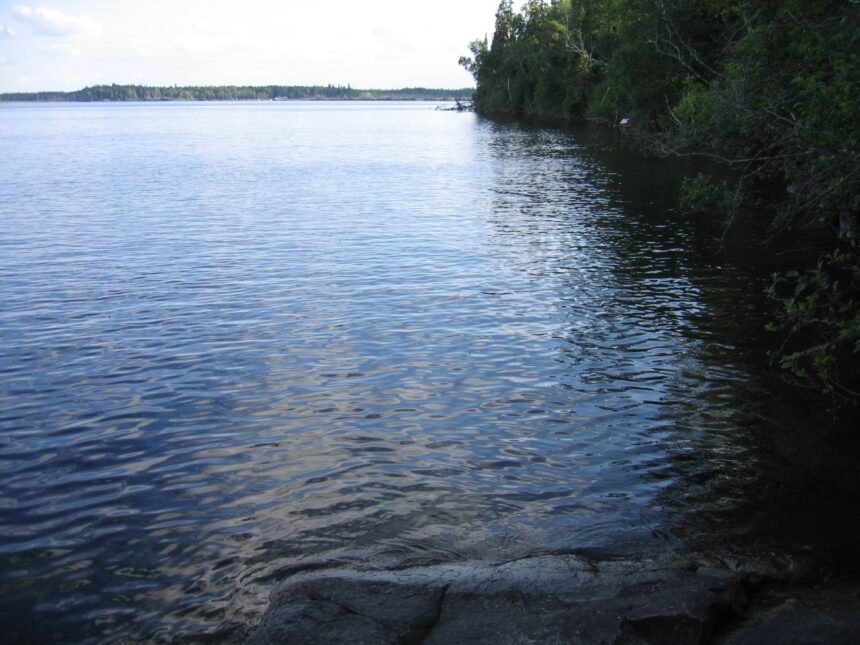
Stefan Michalak, a 50-year-old Winnipeg mechanic and amateur prospector, was examining a rock formation near Falcon Lake in Manitoba’s Whiteshell Provincial Park, about 90 miles east of Winnipeg, around noon on May 20, 1967. In his account, two disc-shaped objects descended. One hovered 10 to 12 feet above the ground, then flew off at great speed. The second landed a few hundred feet away.
Michalak said he approached the landed object and saw a door open in its side. Voices came from inside, and a bright yellow-blue light blocked his view of the interior. He tried to speak to whoever was inside — in English, Russian, German, Italian, French, and Ukrainian. Nobody answered. Then the door closed, the object began to rotate with a whining noise, and Michalak reached out with his left gloved hand and touched it beside a grill-like vent. The glove burned the moment he touched the surface. As the craft lifted off, a blast of hot exhaust gas burned his cap, his shirt, and his chest and abdomen.
At about 3 p.m., Michalak flagged down Constable G. A. Solotki of the Falcon Beach Highway Patrol on the Trans-Canada Highway. The constable saw the burn on his hat and marks on his chest, and noted that he smelled no alcohol on the man. Michalak took a Greyhound bus home to Winnipeg and was treated that night at the Misericordia Health Centre for first-degree burns to his upper abdominal wall.
The case at a glance
| Fact | Detail |
|---|---|
| Date | May 20, 1967, around noon |
| Place | Near Falcon Lake, Whiteshell Provincial Park, Manitoba, Canada |
| Witness | Stefan Michalak, 50, industrial mechanic and amateur prospector from Winnipeg |
| What he reported | Two disc-shaped objects; one landed; voices from inside; glove burned on contact; exhaust burned his chest and abdomen |
| Medical record | First-degree burns to the upper abdominal wall, treated at Misericordia Health Centre, Winnipeg, the same night |
| Investigators | RCMP, Royal Canadian Air Force, Department of National Defence, Manitoba Department of Health — plus the U.S. Condon Committee |
| Physical evidence | Burned shirt and glove; soil samples from the site later found radioactive |
| Official status | Still listed as unsolved by Canada’s Department of National Defence |
The radioactive soil — and the natural explanation
The strangest part came a month later. Despite promising not to disturb the site, Michalak returned on June 26 with a companion and brought back soil, moss, a steel tape, and remnants of his burned shirt. Tests found the samples radioactive. In July, a federal radiation officer found a small patch of radium-226 contamination — no larger than 100 square inches — in a crack in the rock.
That sounds like strong evidence — until the follow-up. In 1969, a scientist at Canada’s National Research Council judged it “highly probable” that crushed uranium ore, which occurs naturally in the area, produced all the radioactivity reported. No radioactivity had been found on Michalak or his clothes in the May checks, and the U.S. Air Force-funded Condon Committee concluded the case did not provide probative evidence of unconventional craft.
The burns that came back
One more twist: in 1968, Michalak told reporters his burns had returned, and photographs showed a neat grid-like pattern of marks that looked very different from the irregular burns photographed in May 1967. A psychiatrist who examined the case concluded the new wounds were likely self-inflicted. That finding does not erase the May 1967 hospital record — the first-degree burns treated that night are a documented medical fact — but it shows why investigators grew cautious, and why the burns alone cannot settle what happened at Falcon Lake.
What the files do — and do not — prove
The paper trail here is unusually strong: a police report from the same afternoon, a hospital record from the same night, months of investigation by four Canadian agencies, soil tests, and a federal radiation memorandum — all preserved at Library and Archives Canada. What the files do not contain is proof of alien technology. No other person saw the objects. No wreckage was recovered. The radioactivity has a likely natural explanation. “Unsolved” is the correct official status — but unsolved is not the same as proven. It means the government could not determine what happened, not that it determined a spacecraft landed.
Why Falcon Lake still matters
Falcon Lake shows how a UFO case should be judged — on the documents, not the drama. The RCMP, the air force, and health officials treated the report seriously, searched the ground, tested the soil, and wrote it all down. The result was neither a cover-up nor a confirmation: a file that ends, honestly, with no answer. For readers following the Pentagon’s UAP releases today, that is the right standard — a real injury, a real investigation, and a real mystery are not the same thing as proof of alien craft.