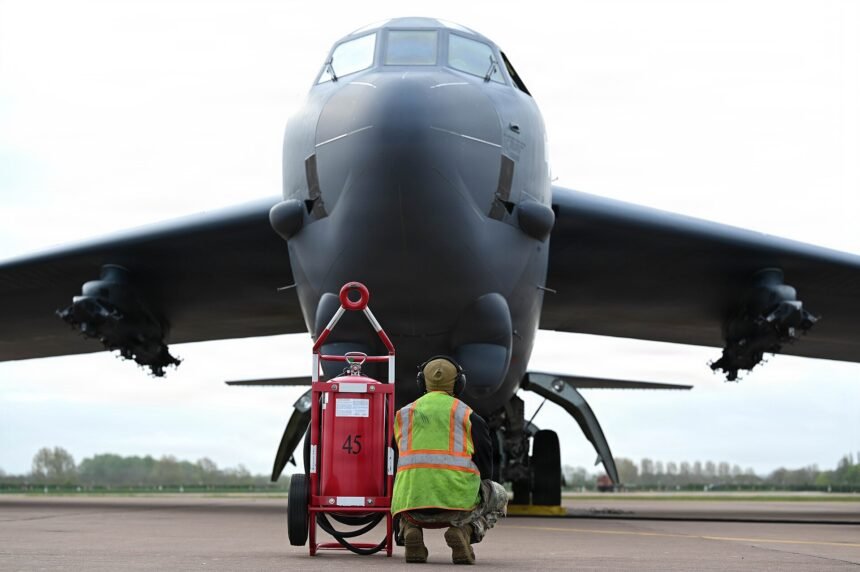
In the early morning hours of October 24, 1968, security and maintenance crews at Minot Air Force Base in North Dakota began reporting strange lights over the Minuteman missile field around the base. Over the next three hours, ground radar tracked an object and a B-52 bomber crew was sent to take a look. What the crew saw — and what their radar recorded — became one of the best-documented UFO cases in American military history. More than 55 years later, it is still listed as unexplained.
The Night the Missile Field Lit Up
Minot was no ordinary airfield. It was a Strategic Air Command base, home to B-52 bombers and to the 91st Strategic Missile Wing, which controlled Minuteman missiles across the North Dakota countryside. Around 2:15 a.m., personnel at the missile sites began reporting unusual lights. Base operations alerted a B-52H already airborne on a training flight. The bomber, call sign JAG 31, was asked to change course and investigate. Its pilot was Major James A. Partin, and the co-pilot and instructor beside him was Captain Bradford Runyon.
JAG 31 Goes to Look
Ground radar at Minot tracked an unidentified object and radioed its position to the bomber. At about 3:30 a.m., it was reported about 24 miles from the aircraft. Minutes later it was 15 miles away. By 3:52 a.m., base weather radar was tracking it too, now about three miles from the B-52. The navigator watched a return on the bomber’s own radarscope hold steady at the same altitude, about three miles off, through a 180-degree turn. Then the object closed fast: a bright red-orange glow about one and a quarter to one and a half miles off the bomber’s left side, with a closing rate of around 3,000 miles per hour. During the close encounter, both of the B-52’s UHF radios failed to transmit for about four minutes, coming back only after the object moved away. The crew photographed their radarscope, and 13 of those photographs survive in the official case file.

The Object on the Ground
The encounter was not over. Controllers vectored the B-52 to overfly a stationary glowing object on or near the ground, and the pilots watched a large illuminated object ahead of the aircraft for several minutes before passing over it at close range. After the bomber landed, alarms went off at a remote missile site, Launch Facility Oscar-7 — both the outer and inner zone intrusion alarms. A hatch at the site was later found open, with its padlock removed. The official file treated that break-in as a separate matter, unrelated to the sighting. In all, the reported observations ran from about 2:15 a.m. to 5:34 a.m., and 17 witnesses were later interviewed.
| Date and time | October 24, 1968, about 2:15 a.m. to 5:34 a.m. CDT |
| Location | Minot Air Force Base and missile field, North Dakota |
| Aircraft | B-52H Stratofortress, call sign JAG 31 |
| Crew | Major James A. Partin, Captain Bradford Runyon |
| Closest radar range | About 1.25 to 1.5 miles |
| Reported closing speed | About 3,000 mph |
| Radarscope photographs | 13 |
| Project Blue Book case | Case 12,548, 145 pages |
What Project Blue Book Decided
Project Blue Book investigated the case and built a file of 145 pages, including witness questionnaires, maps, logs, and the radarscope photographs. Its final report did not settle on one answer. It suggested the sightings were possibly a combination of anomalous propagation of radar returns, a plasma ball, and celestial bodies. The case then went quiet for about 30 years, until Runyon contacted the Center for UFO Studies in 2000 and filed a detailed report. Researchers later interviewed the surviving witnesses and published the full record, including the controller transcripts, as part of the Sign Oral History Project.
What Is Still Unproven
No file in the Minot case contains proof of alien technology. No craft was recovered, no debris was collected, and no witness claimed to see beings. What the record does show is unusual: trained military personnel, multiple radars, a bomber crew, and a nuclear missile site all involved in the same night, with 13 photographs of a radar return never convincingly matched to the official explanations. That is why the Minot incident still matters. It is not evidence that aliens visited North Dakota in 1968. It is evidence that, on one night in 1968, the United States Air Force recorded something it could not explain — and the explanation it offered has not held up to the evidence in its own file.