In the early hours of Boxing Day 1980, American airmen guarding a United States Air Force base in eastern England chased strange lights into a dark pine forest. Two nights later, their deputy base commander went back into the same forest with a tape recorder — and came out with an official memo that still makes the Rendlesham Forest incident the most famous UFO case in British history. It is often called “Britain’s Roswell.” But unlike Roswell, this case has paperwork: a signed memo, tape-recorded observations made on the spot, and witness statements written within days.
No file connected to Rendlesham Forest contains proof of alien technology. What it does contain is a genuine puzzle — and a lesson in how easily a lighthouse, a fireball, and a cold December night can be mistaken for something else.

The First Night: December 26, 1980
Around 3:00 a.m. on December 26, 1980, a security patrol near the east gate of RAF Woodbridge in Suffolk, England, saw lights apparently descending into nearby Rendlesham Forest. The base was operated by the United States Air Force during the Cold War, and the patrol’s first thought was that an aircraft had crashed. Three airmen — Staff Sergeant Jim Penniston, Airman John Burroughs, and Airman Edward Cabansag — were sent into the forest on foot to investigate.
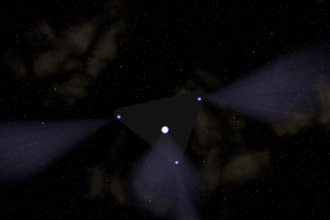
According to the official memo written later by the deputy base commander, the patrolmen reported “a strange glowing object in the forest.” It was described as metallic in appearance and triangular in shape, roughly two to three meters across the base and about two meters high. It lit the whole forest with a white light, had a pulsing red light on top and a bank of blue lights underneath, and was hovering or standing on legs. As the men approached, it moved away through the trees and disappeared. Farm animals nearby went into a frenzy.
Penniston’s own written statement, filed within days of the event, said the object was “definitely mechanical” but also said he was never closer than about 50 meters from it. The dramatic details many people know today — that he touched the craft, felt it warm, and found strange symbols on its surface — did not appear in his original statement. They entered his account decades later, and no other witness corroborated them.
Read also: The McMinnville UFO Photographs of 1950: Two Pictures From an Oregon Farm — and 75 Years of Argument
The Marks on the Ground
The next day, investigators found three small depressions in the forest floor where the object had reportedly been seen — each about 1.5 inches deep and 7 inches across, arranged in a triangle. That night, the deputy base commander, Lieutenant Colonel Charles I. Halt, returned to the site with several servicemen and a radiation meter.
The readings were small but real: peak beta/gamma readings of about 0.1 milliroentgens per hour in the three depressions, against a background level of 0.03 to 0.04 milliroentgens per hour elsewhere in the forest. A nearby tree showed slightly raised readings on the side facing the depressions. The numbers were far below any dangerous level, and radiation alone proves nothing about what made the marks — but the readings were written down, on the record, by serving officers.
The Second Night: Halt’s Tape Recorder
On the night of December 28, 1980, Halt led a party back into the forest after fresh reports of lights. This time he carried a micro-cassette recorder and narrated what he saw as it happened. The tape is one of the most unusual documents in UFO history: a senior officer recording his own confusion in real time.
Halt described a red, sun-like light moving through the trees. At one point it appeared to throw off glowing particles, then broke into five separate white objects and disappeared. Soon after, three star-like objects appeared in the sky — two to the north and one to the south, about 10 degrees above the horizon — moving rapidly in sharp, angular movements and showing red, green, and blue lights.
Shortly after 4:00 a.m. on the first night, local police had been called to the scene. The officers reported that the only lights they could see were those of the Orford Ness lighthouse, several miles away on the coast.
| Night | What happened | What was recorded |
|---|---|---|
| Dec 26, 1980, ~3:00 a.m. | Patrol sees lights fall into the forest; three airmen follow on foot | Witness statements written within days |
| Dec 27, 1980 | Three depressions found in the forest floor | Radiation readings slightly above background |
| Dec 28, 1980, early hours | Halt’s party returns; red light seen through the trees | Micro-cassette tape recording, made live |
| Jan 13, 1981 | Halt sends his memo to the Ministry of Defence | One-page memo titled “Unexplained Lights” |
The Memo That Made It Official
On January 13, 1981 — about two weeks after the events — Halt sent a one-page memo titled “Unexplained Lights” to the British Ministry of Defence. It was written on official U.S. Air Force letterhead and signed by the deputy base commander. The memo was released to the public in June 1983 under the U.S. Freedom of Information Act, and the story broke in Britain’s News of the World in October 1983 under the headline “UFO lands in Suffolk — and that’s official.”
The memo is the reason this case is different from most UFO stories. It is not a rumor or a late memory. It is a serving officer telling his government, in writing, that his men saw something they could not explain.
The Lighthouse Question
Skeptics have offered a grounded explanation for much of what the airmen saw. Astronomers attributed the first night’s descending lights to a piece of natural debris burning up as a fireball over southern England around the same time. The flashing red light seen across the fields on both nights lines up with the Orford Ness lighthouse, whose beam sweeps the coast a few miles from the forest — and researchers later photographed the lighthouse flashing through a gap in the trees from exactly the spot where Halt had stood. The star-like objects that moved in sharp jumps may have been bright stars, seen through thin cloud and moving trees.
The UK Ministry of Defence stated that the event posed no threat to national security and was therefore never investigated as a security matter. Its files on the case are now public at the National Archives in Kew, London.
What Is Still Unproven
More than 45 years later, Rendlesham Forest remains unresolved — and that is exactly why it matters. The witnesses were trained military personnel, not casual skywatchers. Their commander put his name on a memo. Their tape recorder captured the night as it happened. And yet every striking detail in the case has a plausible ordinary explanation: a fireball, a lighthouse, bright stars, and ground marks that could have many causes.
No document, photograph, or piece of debris from Rendlesham Forest has ever been shown to be alien technology. The case does not prove that extraterrestrials visited Suffolk in December 1980. What it proves is that honest, disciplined people can see something they cannot explain — and that the explanation, when it comes, is often closer to home than anyone expected. Until someone produces harder evidence, that is where the story stands.