On the night of October 18, 1973, four U.S. Army Reserve airmen were flying a routine trip home to Cleveland when something no pilot wants to meet appeared over Mansfield, Ohio: a silent, cigar-shaped object that chased their helicopter, bathed the cockpit in green light, and — while the pilot was trying to descend — lifted the aircraft nearly 2,000 feet into the air. More than fifty years later, the Coyne helicopter incident is still one of the most credible UFO encounters on record, and it still has no official explanation.
A Routine Flight Home
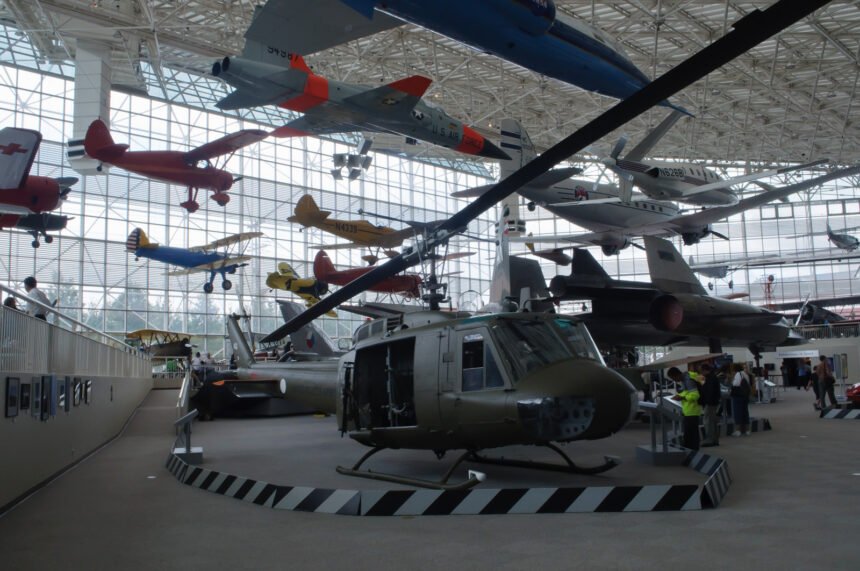
The flight began as ordinary as a military flight gets. At about 10:30 p.m., a Bell UH-1H “Huey” helicopter of the U.S. Army Reserve left Port Columbus, Ohio, bound for its home base at Cleveland Hopkins Airport, about 96 nautical miles to the north-northeast. In command was Captain Lawrence J. Coyne, 36, a pilot with 19 years of flying experience. At the controls sat First Lieutenant Arrigo Jezzi, 26, a chemical engineer. Behind them were Sergeant John Healey, 35, a Cleveland policeman serving as flight medic, and Sergeant Robert Yanacsek, 23, a computer technician and the crew chief. The helicopter cruised at 2,500 feet and 90 knots under a clear, starry sky.
Read also: The Mantell UFO Incident of 1948: The Fighter Pilot Who Died Chasing a UFO
The Red Light That Turned Toward Them
About 11 p.m., roughly 10 miles south of Mansfield, Healey noticed a single red light to the west, flying south. A few minutes later, Yanacsek spotted another red light on the southeast horizon. Coyne told him to keep an eye on it, assuming it was distant air traffic. About 30 seconds later, Yanacsek reported that the light had turned toward the helicopter and appeared to be on a collision course.
Coyne took the controls from Jezzi and put the Huey into a powered descent of about 500 feet per minute. He radioed the Mansfield control tower to ask about other aircraft in the area. The tower acknowledged the call — and then all radio contact was lost, on both UHF and VHF. The last Air National Guard F-100 at Mansfield had landed at 10:47 p.m., so there should have been no jet in the sky at all. The red light kept coming, growing brighter, at a speed Coyne later estimated at more than 600 knots. He steepened the descent to 2,000 feet per minute. The last altitude he noted was 1,700 feet. A collision looked certain.
The Object That Filled the Windshield
Then, at the last moment, the light stopped. Hovering above and in front of the helicopter was a gray, metallic, cigar-shaped object, about 60 feet long, its apparent size filling the entire windshield and blotting out the stars behind it. It had a red light at the nose and a white light at the tail. From its underside came a green beam that swung up over the nose of the helicopter, through the windshield, and into the cockpit, bathing the crew in intense green light. There was no noise and no turbulence. The compass was spinning out of control.

After a few seconds, the object accelerated away to the west, made a distinct 45-degree turn, and headed toward Lake Erie. Only then did Coyne and Jezzi look at their instruments — and find something that made no sense. The altimeter read 3,500 feet, with a rate of climb of 1,000 feet per minute, even though the collective control was still in the full-down position set for the descent. The helicopter kept climbing until, at an indicated altitude of 3,800 feet, Coyne finally felt he had regained positive control. While he had been diving to escape, the aircraft had somehow climbed roughly 1,800 feet.
| The Coyne Incident at a Glance | |
| Date | October 18, 1973, about 11:00 p.m. |
| Location | Near Mansfield, Ohio, over Charles Mill Lake |
| Aircraft | U.S. Army Reserve Bell UH-1H “Huey” |
| Crew | Capt. Lawrence J. Coyne, 1st Lt. Arrigo Jezzi, Sgt. John Healey, Sgt. Robert Yanacsek |
| Object | Gray metallic cigar shape, about 60 feet long |
| Lights | Red at nose, white at tail, green beam from below |
| Unexplained climb | About 1,800 feet, with controls set to descend |
Read also: The JAL Flight 1628 UFO: A 747 Crew, Three Lights Over Alaska
What Happened Next — and What Is Still Unproven
The morning after the encounter, Coyne reported the incident to the Federal Aviation Administration at Cleveland Hopkins Airport. The story spread quickly, and the National Enquirer awarded the four men its Blue Ribbon Panel prize of $5,000 for the most scientifically valuable UFO report of 1973. In 1978, Coyne spoke about the encounter at a United Nations hearing on UFOs. Project Blue Book, the Air Force’s official UFO investigation, had closed in 1969, so the case never received a formal Air Force explanation.
Skeptics have suggested a meteor, a misidentified aircraft, or a trick of the night sky. But none of those explanations accounts for all four crew members seeing the same object at close range, the green light filling the cockpit, the loss of radio contact, the spinning compass, or a helicopter climbing 1,800 feet while its pilot was commanding a descent. That is why UFO researchers still rank the Coyne case among the best-documented encounters ever reported by military witnesses.
At the same time, the honest limits matter. No wreckage was recovered, no radar record of the object has been made public, and no official investigation has confirmed what the object was. The Pentagon’s AARO report of 2024 reviewed 80 years of UFO files and found no evidence of alien technology — and the Coyne incident, dramatic as it is, is not proof of alien craft. It remains what it was on the night of October 18, 1973: a close, multi-witness encounter with something in the sky that nobody has been able to explain.
Sources: Jennie Zeidman, Center for UFO Studies (CUFOS) account of the Coyne helicopter incident; Ohio Magazine, “The Case of Ohio’s Best Documented UFO” (Sept./Oct. 2023); UFO Evidence case file. Featured photo: Bell UH-1H Huey, U.S. Army — Wikimedia Commons, CC BY-SA 2.0, by InSapphoWeTrust. Night-sky photo: Unsplash.